Israeli Operation in Hebron Displaces Thousands and Raises Alarm Over the West Bank's Economic Hub
Days of raids, a lockdown and demolitions in the occupied West Bank city have forced out about 2,500 people, while rights researchers and local officials describe the measures as collective punishment.
By News Media House Staff ·
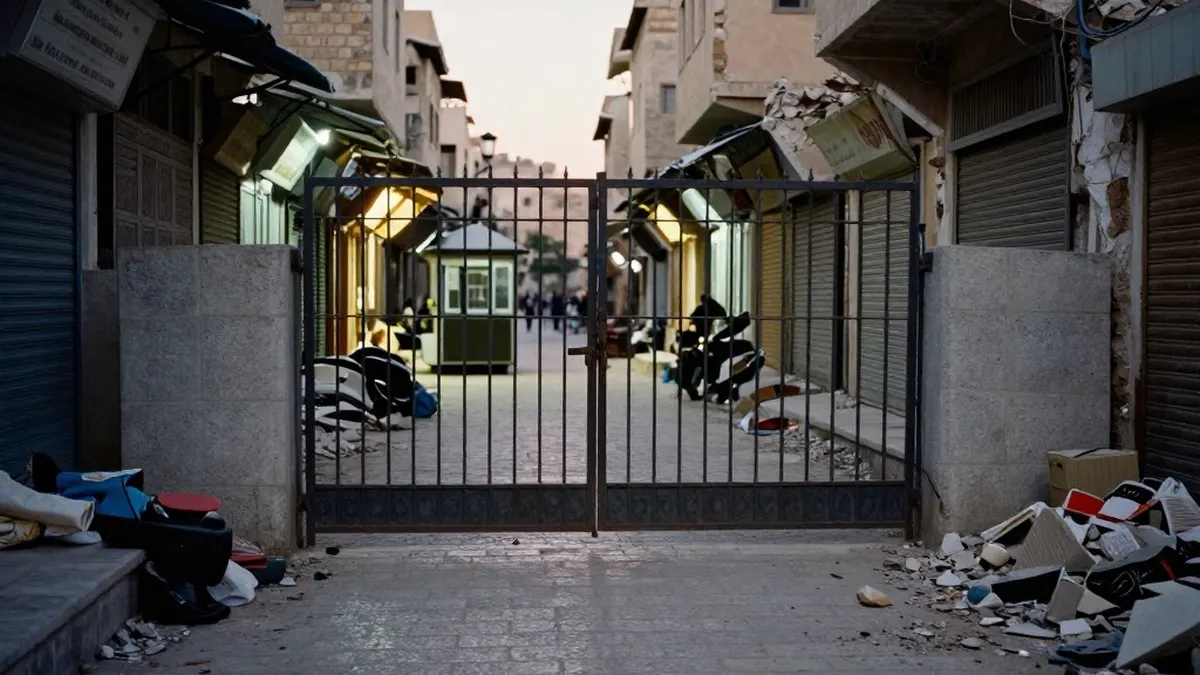
Israeli forces have spent several days raiding the occupied West Bank city of Hebron, imposing a lockdown and forcing residents from their homes. The Palestinian Prisoner's Society says at least 47 Palestinians have been detained across the city since Friday.
About 2,500 people have been pushed out of Hebron, and some Palestinian homes have been turned into military posts and barracks. The operation followed a Friday shooting attack that killed two soldiers. The two Palestinian suspects were also killed.
The lockdown began right after the Friday morning shooting at a military checkpoint in the Farsh al-Hawa area. Once all entrances to the city were shut, Israeli forces started demolishing dozens of Palestinian buildings. Troops also entered the Ein Deir Bahha neighbourhood at night and made dozens of families leave without their belongings. Hebron municipality data indicates the affected area covers 350 dunams, or about 86 acres, and that nearly 500 families have been uprooted. The measures affect roughly 900,000 Palestinians in the city.
Human rights researcher Hesham al-Sharbati called the actions "a complete eviction campaign for a Palestinian residential neighbourhood" and described them as "a form of ethnic cleansing." He said the collective punishment of the community "amounts to a war crime." Hebron municipal council member Moamar Yousef al-Awiwi said the operation follows a series of steps meant to displace the Palestinian population. Rights groups have compared the assault with the January 2025 "Iron Wall" operation in the Jenin and Nur Shams refugee camps, which displaced more than 30,000 people and destroyed over half of the residential buildings there.
The economic stakes are also high. Hebron produces about 40 percent of Palestinian industrial output and 30 percent of exports, at a time when the Palestinian economy is already in severe crisis. The city also has the densest concentration of military obstacles in the West Bank, with about 40 percent of the territory's 89 main checkpoints located in its most restricted zones. Economic researcher Ahmed Abu Qamar warned that any closure or limit on movement in Hebron will "put pressure on the entire Palestinian economy in the West Bank." He said disrupted supply chains raise production costs and cause missed deliveries, and that many facilities may have to halt work or cut hours to a minimum.
Daily life is further constrained by hundreds of Israeli settlers living in the Old City. Under the 1997 Hebron Protocol, the city was split into H1, nominally under Palestinian civil control, and H2, which makes up 20 percent of the city and stays under full Israeli security control. About 7,000 Palestinians live in H2. Israeli authorities have steadily widened closed zones around settlements in the city centre, which are illegal under international law. In early October, three iron gates were installed across a 200-metre stretch of the Old City, cutting off commercial routes such as Shuhada Street, where more than 500 shops have been forced to close over the years. In winter, many residents use dangerous, unlit paths through cemeteries to get around closures and bag searches.
At the centre of H2 stands the Ibrahimi Mosque, which Jews call the Tomb of the Patriarchs. The 14th-century site lies within the Old City, a UNESCO World Heritage Site, and has been the target of numerous attacks by settlers. In 1994, an American-Israeli settler opened fire inside the sanctuary and killed 29 Palestinian worshippers. The Israeli military then permanently partitioned the site and sharply restricted Palestinian access to nearby neighbourhoods.
Israeli Finance Minister Bezalel Smotrich has now announced that Israel is taking over planning and construction powers for the mosque and the surrounding H2 zone, removing the Palestinian municipality's oversight. Smotrich said he had abolished key parts of the 1997 Hebron Agreement, a shift that further entrenches the occupation in the city.
Originally published by News Media House · Source: Al Jazeera